
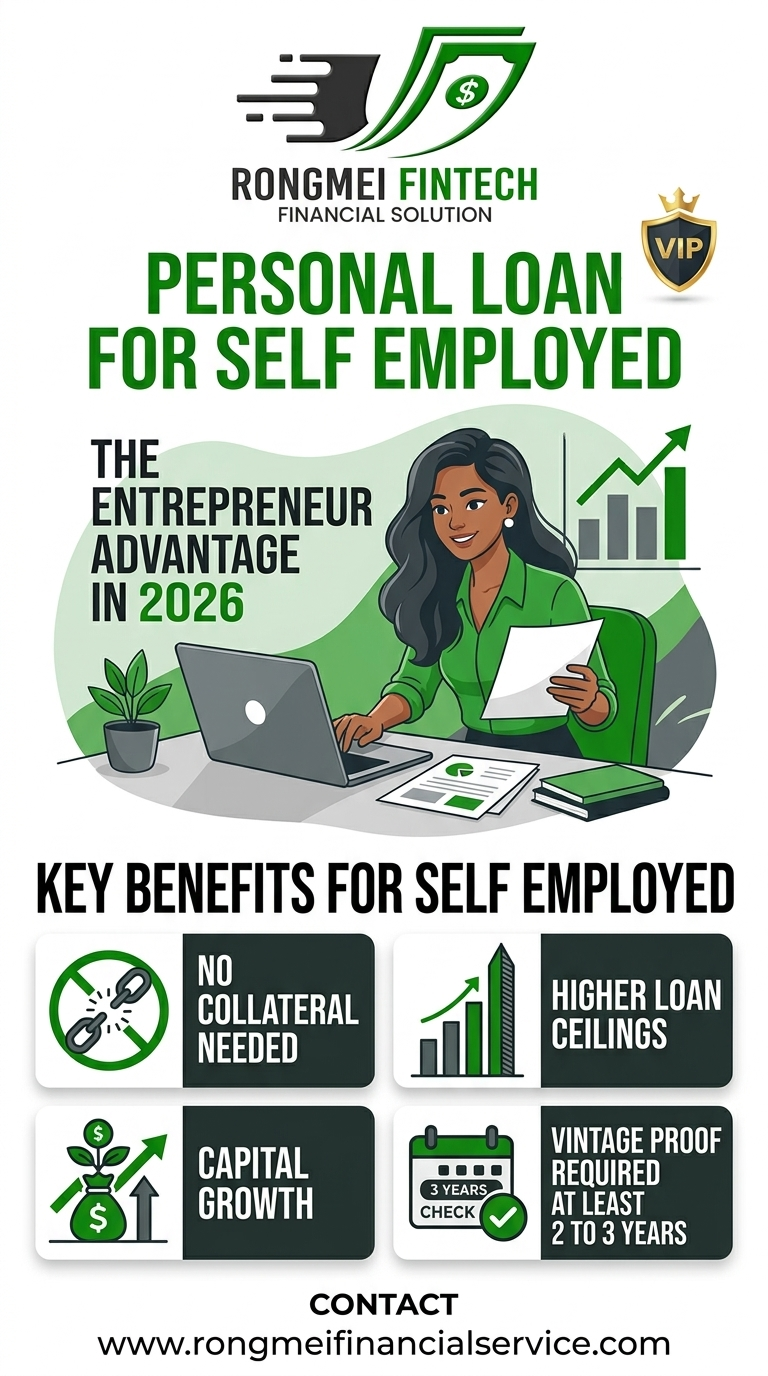
Personal Loan for Self Employed
The "Entrepreneur Advantage" in 2026
Lenders no longer just look at a flat salary. They now use GST-linked analytics and cash-flow banking to determine your eligibility. This means even if your monthly income fluctuates, a healthy business turnover can secure you a high-value loan.
Key Features for the Self-Employed:
No Collateral Needed: These are unsecured loans, meaning you don’t have to risk your office equipment or property.
Higher Loan Ceilings: Eligible professionals can often access up to ₹15 Lakh to ₹50 Lakh, depending on business vintage.
Capital for Growth: Unlike a business loan, a personal loan doesn't require you to submit a "project report" on how you’ll use the money.
| Criteria | Typical Requirement |
| Business Vintage | At least 2 to 3 years in the same profession/business. |
| Age | 22 to 58 (some lenders extend to 65). |
| Annual Income | Minimum ITR of ₹2 Lakh to ₹5 Lakh (varies by lender). |
| Credit Score | 750+ is the gold standard for competitive rates. |
| GST Filings | Regular GST returns (if applicable) act as strong proof of activity. |
The Hidden Perk: Tax Deductions for Business Owners
While personal loans are generally not tax-deductible, self-employed individuals have a major loophole under Section 37(1) of the Income Tax Act:
The Rule: If you use the personal loan funds entirely for business purposes (buying inventory, paying rent, or upgrading office tech), the interest paid on the loan can be claimed as a legitimate business expense.
This deduction reduces your net taxable profit, effectively lowering your tax outgo. Just ensure the loan amount is credited to or used via your business account to maintain a clear paper trail.
Documentation Checklist
Since you don’t have a salary slip, your paperwork is your "voice." Keep these digital copies ready:
KYC: PAN Card and Aadhaar (linked to your mobile for e-KYC).
Address Proof: Voter ID, Passport, or recent utility bills.
Financials: Last 2 years of ITR (with computation of income), P&L Statement, and Balance Sheet.
Banking: Last 6 to 12 months of your primary current/savings account statement.
Business Proof: GST registration, Trade License, or Establishment Certificate.
Pro-Tips for a Smooth Approval
Maintain a Healthy Average Monthly Balance (AMB): Lenders look at your "stability." Avoid letting your account hit near-zero balances.
Declare All Income: When filing your ITR, ensure you represent your income accurately. A higher declared income directly correlates to a higher loan eligibility.
Separate Personal & Business: Even if you are a freelancer, try to keep your business transactions separate. It makes the lender's "credit assessment" much faster.
Final Thought: A personal loan for the self-employed is more than just "extra cash"—it’s a tool for agility. Whether you're bridging a seasonal gap or seizing a sudden growth opportunity, 2026 is the year of flexible, digital-first lending.
Are you looking to use a loan for a specific business expansion, or are you more interested in consolidating some existing high-interest debts?
Contact Our Team - 8011358502 Or Fill the Query Leads Form.